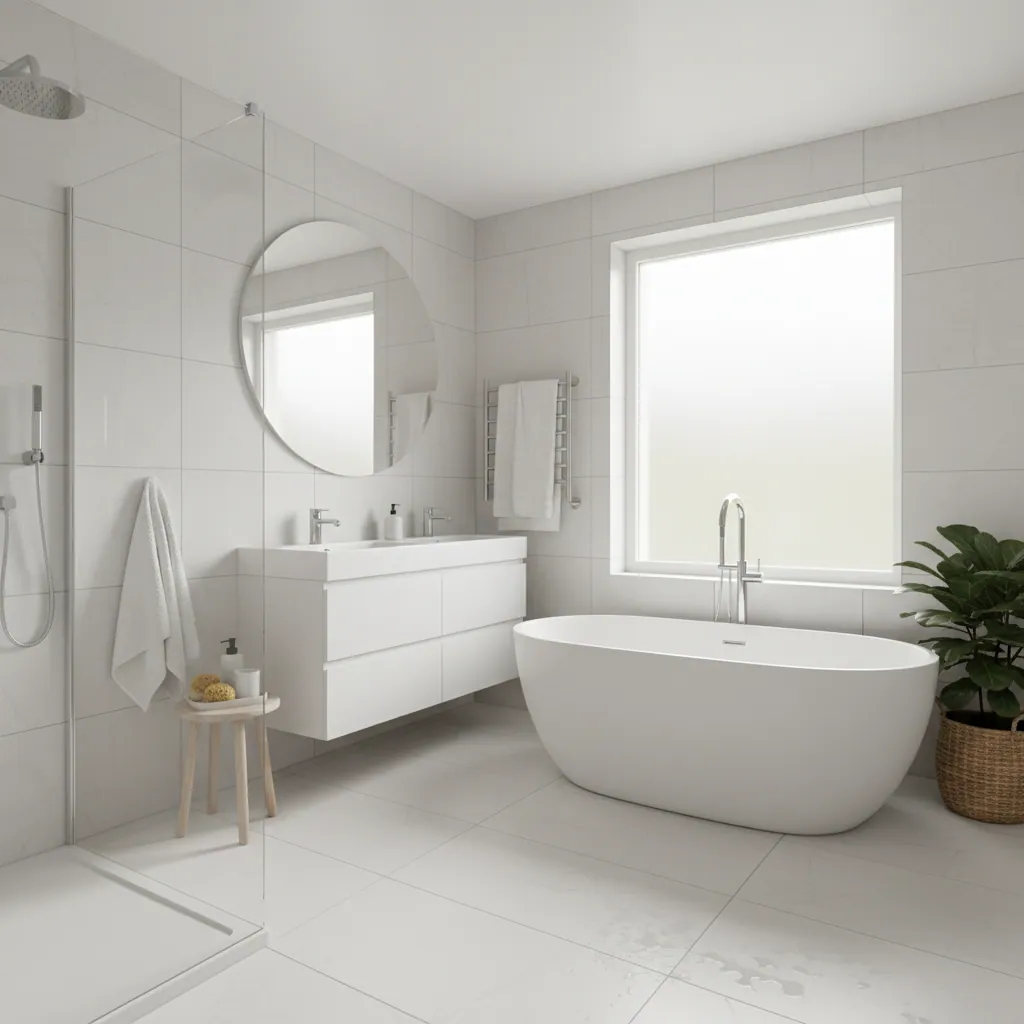
Accessible & mobility bathrooms · Plymouth
Most people redo a bathroom once a decade or two, and most people would rather stay in their own home as they get older than move because of a room. Put those two facts together and there is an obvious, quietly clever move: when you renovate now, build the bathroom so it can adapt to whatever later life brings — without ripping it out and starting again. Future-proofing does not mean fitting grab rails and a hospital seat into a room you do not yet need. It means putting the invisible groundwork in place while the walls are already open, so the room looks like a normal, beautiful bathroom today and can become a fully accessible one in an afternoon if it ever needs to. It costs very little extra now and saves a great deal later. This guide explains what is worth building in, why the timing matters so much, and how we do it. It is part of our accessible bathrooms service across Plymouth and the South West.
Why the timing is everything
The single most expensive and disruptive part of making a bathroom accessible is not the rail or the seat — it is opening up the walls and floor to fit them safely. During a renovation, all of that is already open. Building solid backing behind the tiles, choosing a level shower and laying out the room with a little extra space add almost nothing to a job you are doing anyway. Come back to retrofit the same things in five or ten years and you are paying for a second strip-out, a second mess and a second week without a bathroom.
That is the whole case for future-proofing, and it is why we raise it with anyone renovating a bathroom, not only those with an immediate accessibility need. You are not committing to a mobility bathroom; you are simply keeping the door open, cheaply, for the day you might want one. It fits naturally into a standard bathroom installation or renovation, and it means your next bathroom project might be a quick add-on rather than another full refit.

What is worth building in now
- Solid backing behind the walls at every likely grab-rail position, so rails can be added later exactly where needed, safely, without disturbing the tiling. This is the highest-value, lowest-cost thing we do.
- A level-access or easily-levelled shower instead of a high tray, so a step never has to be removed. A walk-in shower today can become a full wet room tomorrow with minimal work.
- A layout with room to move — clear floor space to turn, and space for a carer to stand alongside if that day ever comes.
- A thermostatic shower with an easy-reach, easy-grip control that guards against scalding and suits weaker hands.
- Lever taps and simple controls that stay easy to use whatever your grip is like.
- Slip-resistant flooring that looks good and is safer at any age — see our slip-resistant flooring guide.
How we future-proof, step by step
1. Backing in the walls
Plywood or noggins go in behind every likely rail position before the room is tiled, so support is safe to add later without ripping anything out.
2. A level shower
We fit a level-access or easily-levelled shower so a step never becomes a problem, and set drainage ready to convert to a full wet room if wanted.
3. A spacious layout
We plan clear floor space to turn and to allow a carer alongside, keeping the route between door, WC and basin simple.
4. Age-friendly fittings
A thermostatic shower, lever taps, a comfort-height WC and slip-resistant flooring that suit any age from the first day.
Done together, these mean the room needs no drama later. Adding a grab rail becomes a short visit rather than a rebuild, and swapping in a shower seat is straightforward because the space and the fixings are already there. A comfort-height WC is an easy, comfortable choice at any age too.
It still looks like a lovely bathroom
The best thing about future-proofing is that you would never know it had been done. There is no clinical look and no compromise on style — just a handsome, modern bathroom whose clever parts are all hidden in the walls and the floor. You get the room you actually want now, and the reassurance that it can flex if your needs, or a parent’s, ever change. For many of our Plymouth customers, that peace of mind is the whole reason to do it.
Value, cost and staying put
A bathroom that suits any age and ability has broad appeal, and walk-in showers in particular are popular with buyers. More importantly, it supports the wish most people share — to stay in their own home for as long as they can. Where future changes are made because of a disability, they may also qualify for VAT relief. For what all of this costs in Plymouth, see our cost of a bathroom guide, and our accessible bathrooms hub for the wider picture.
The cost of doing it now versus later
The whole argument for future-proofing comes down to a comparison, so it is worth making it plainly. Adding solid backing behind the walls during a refit is a small material and labour cost on a job where the walls are already stripped. Come back to fit a grab rail properly in five years and, if that backing is not there, the honest options are either drilling in the hope of finding something solid — which often is not where you need the rail — or opening up the tiling, adding backing, re-tiling and re-grouting. That is a day or two of work, a mess in a finished room, and a bill for something that would have cost very little the first time.
The same logic runs through every part of it. Levelling a shower later means lifting a tray, reworking drainage and re-waterproofing; building it level now costs almost nothing extra. Widening a doorway after the fact means making good walls and possibly flooring; allowing for it in the layout now is free. None of this is about spending more today — for the most part it is about spending the same money a little more cleverly, and saving a second, larger bill down the line. Set against the figures on our cost of a bathroom in Plymouth page, the future-proofing premium is genuinely small.
Future-proofing in a Plymouth home
The upstairs family bathroom
In the 1960s–90s houses common across Plympton, Plymstock and Woolwell, the main bathroom is usually upstairs. Future-proofing here means a level or low-step shower rather than a bath-shower over a high side, backing behind the walls for rails, and a layout that leaves room to move. If you are replacing the bath anyway, a walk-in shower with hidden backing is the obvious future-friendly swap — and if a bath is still wanted for children, we can plan the room so a bath can later give way to a level shower without moving the plumbing.
Adding a downstairs shower room
One of the smartest future-proofing moves in a two-storey Plymouth home is creating a shower room on the ground floor — often carved out of a cloakroom, utility or under-stairs space. It means that if stairs ever become difficult, safe washing is already on the living floor, frequently near a room that could become a bedroom. Built level from the start on a solid ground floor, it is one of the easiest places to make a fully step-free room, and it adds a genuinely useful second facility in the meantime.
Whichever applies to your home, the principle is the same: we look at how you live now and how that might change, then build a bathroom that can move with you. Much of the groundwork overlaps with a standard bathroom renovation, so it rarely means a bigger project — just a better-thought-through one.
How it connects to everything else
Future-proofing is really the thread that runs through our whole accessible bathrooms range. A future-proofed bathroom might one day gain the grab rails whose backing you built in, a shower seat in the space you left, or become a full wet room because the drainage was set ready. Doing the thinking once, now, keeps all of those doors open cheaply.
Peace of mind, built in
For most of our customers the real value is not a line on a survey or a resale figure — it is knowing the room will not let them down. Whether you are planning for your own later life or arranging things so a parent can stay in the family home longer, a bathroom that can adapt quietly and quickly is one less thing to worry about. We are happy to walk the room with you, point out the handful of things worth building in, and put it all in one clear written quote.
Signs it is worth future-proofing now
Future-proofing is not right for everyone at every moment, but there are some clear signs it is worth building in on your next bathroom. If any of these ring true, it is a conversation worth having before the tiles go on.
- You plan to stay put. If this is your long-term home rather than a stepping stone, designing the bathroom to grow with you saves an upheaval later.
- You are already over a bath you rarely use. Swapping a little-used bath for a level walk-in shower is the single most common — and most future-friendly — change.
- Someone in the household has an early or progressive condition. Building in backing and a level floor now means adapting later is quick and undisruptive.
- You are caring, or may care, for an older relative. A bathroom ready for a grab rail or a seat makes that far easier if the day comes.
- You are renovating anyway. The best reason of all — the walls are open, so the groundwork costs very little to add.
If none of these apply, there is no pressure to do it — we will never sell you something you do not need. But if one or two do, spending the same money a little more wisely now is usually the smart call. Talk it through with us at the visit and we will be straight about what is and is not worth doing for your home.
Frequently asked questions
What does future-proofing a bathroom actually mean?
It means designing and building a bathroom now so it can adapt later without being ripped out. In practice that is solid backing behind the walls for future grab rails, a level or easily-levelled shower, a layout with room to move, and sensible choices like a thermostatic shower and slip-resistant floor. Most of it is invisible and adds little to the cost today, but it saves a great deal of money and disruption if needs change.
Isn’t it too soon to think about this?
If you are already renovating, it is exactly the right time. The expensive, disruptive part of any accessible change is opening up walls and floors — and they are already open during a refit. Building in the hidden groundwork now costs very little; retrofitting it later means a second job, a second mess and a second bill. Future-proofing is simply making the most of work you are doing anyway.
Will a future-proofed bathroom look like a mobility bathroom?
No — and that is the point of doing it well. A future-proofed bathroom looks like a normal, attractive modern bathroom. The clever parts are hidden: plywood backing behind the tiles, a shower that is already level or easy to level, drainage and a layout ready to adapt. You get a beautiful room today and the option to add rails or a seat in an afternoon tomorrow, without anyone re-tiling.
What are the most valuable things to build in now?
Three stand out. First, solid backing behind every likely grab-rail position, so rails can be added safely later. Second, a level-access or easily-levelled shower rather than a high tray, so a step never has to be removed. Third, a layout with enough clear floor space to turn and to allow a carer alongside. Add a thermostatic shower, lever taps and slip-resistant flooring and you have covered most of what later life might ask of the room.
Does future-proofing add value to my home?
It can. A level-access shower and a bathroom that suits any age and ability appeal to a wide range of buyers, and walk-in showers in particular are popular and hold their appeal well. Just as importantly, it lets you stay in your own home longer if that is what you want. See our cost guide for the numbers behind these choices.
Bathrooms for real life
Build it once, adapt it easily
Renovating now? Let us build in the hidden groundwork so your bathroom can adapt to later life without a second refit. We will visit, plan it around you and give you one clear written quote.